


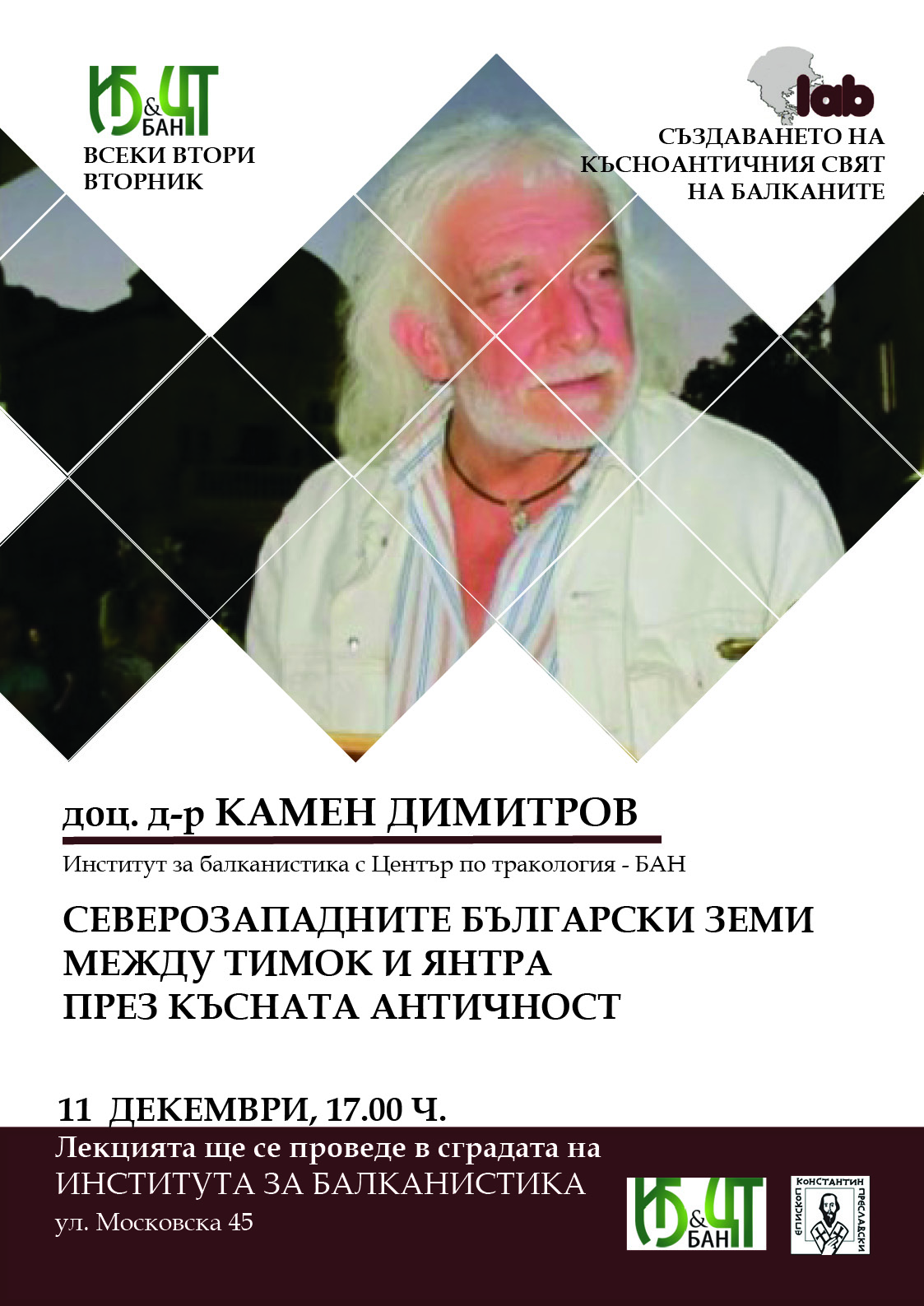
 We have the pleasure to invite you to the lecture of the Assoc. Prof. Kamen Dimitrov, PhD ‘The Northwestern Bulgarian lands between the Rivers Timok and Yantra in Late Antiquity’ which will take place on December 11, 2018 at the Institute of Balkan Studies, located on Moskovska Street No. 45. The Lecture is part of the Initiative ‘Each Second Tuesday’ and project ‘Creation of the Late Antique World on the Balkans’.
The area under discussion was incorporated as a border area of the Late Roman Empire (after 395 – East Roman Empire) whose development was in general following a line of centralisation. Imperial foreign policy was focused mainly on protection of borders from external invasions through maintenance of the defensive fort infrastructure at Lower Danube limes and the military units that were stationed there. These forts were also centers and infrastructure for suppliers and trade with barbarians including, mostly through the Danube settlements.
Since the beginning of the 4th century, military and civil forms of life have developed in parallel, reflecting urban planning. The new structures were subjected to constant hardships by numerous invasions of barbarians. Some of the barbarians were settled as foederati through foedus agreements in imperial lands. They had to protect the land for which they received an annual payment. Federative settlements (i.e. founded by Foederati) such as those in Sadovets, Dichin, Sukidava, Yatrus, etc. have been excavated and well-studied by archaeologists. Other barbarian groups held imperial territories on their own. They played an important role not only for their demographic and cultural image, but also for the local economy.
Initially the barbarians (the Goths in the 4th century) adapted to the local economical and cultural development. It is important to note that these people played a crucial role in the process of Christianisation of the region (with an inclination to the Eastern Christianity as the Goths followed Aryanism). On a religious scale, the Goths played a key part in the Eastern Roman Emperors plans for the region. Some individuals from barbarian descent took high positions in the military and administrative structure of the Empire. Later the barbarian groups (Huns, Proto-Bulgarians, Slavs, Avars) during the 5th-7th centuries had a generally destructive attitude towards the imperial system, even by following a policy of depopulation and by prohibiting the processing of large areas. This process has led to the progressive decline and final disappearance of urban centers and culture in the period from about 580 to the first decades of the 7th century.