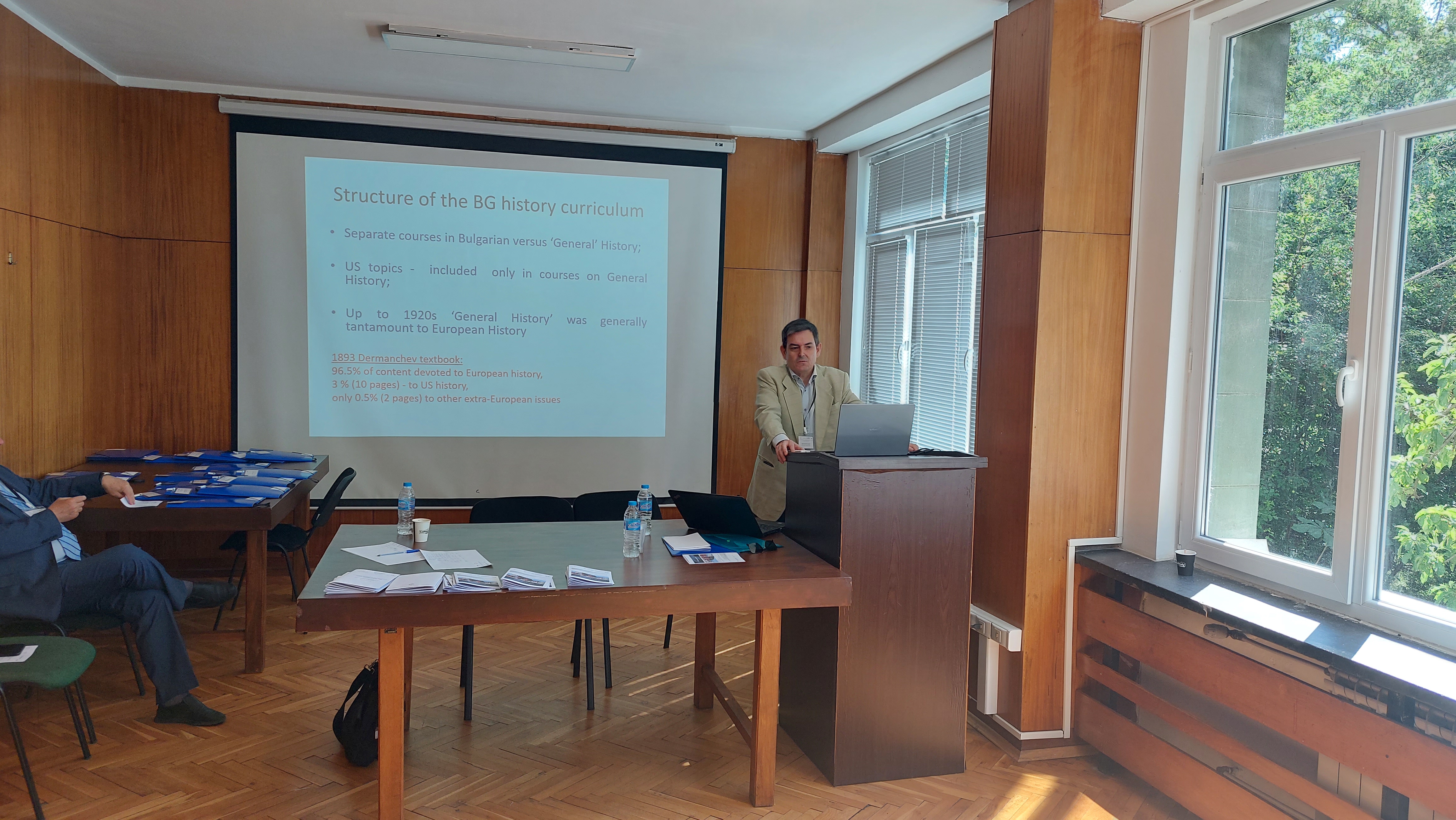
On June 15 and 16, 2024, the Institute of Balkan Studies with the Center for Tracology at the BAS, the Council for Foreign Bulgarian Studies at the Board of Directors of the BAS and the Association for Bulgarian Studies of the USA hosted the twelfth joint conference of Bulgarian and American scholars "Living Bridges Across Time".
A total of 43 established scientists and young specialists from Bulgarian and North American scientific institutes and universities participated in the scientific forum. The program included ten sessions, in which the subject of analysis and discussion were a wide variety of problems in the field of sociology, cultural studies, cultural anthropology, literature, linguistics and history, all related to Bulgarian-American relations.
The scientific forum was opened by the chairman of the Council for Foreign Bulgarian Studies at the Board of the BAS, corresponding member Prof. Alexander Kostov, DSc, who emphasized the importance of the event and the opportunity it provides to scholars of Bulgaria from all over the world to present their scientific discoveries. He also wished successful work to the participants, noting that it is the discourse between specialists that stimulates academic progress.
The director of the Association for Bulgarian Studies, Dilyana Ivanova Ziske, PhD, gave a solemn address to the participants and guests, who emphasized the role of such forums in the development of Bulgarian-American scientific relations.
Support for the organized academic event was also expressed by the national coordinator and scientific secretary of the BAS in the direction "Cultural-Historical Heritage and National Identity", Assoc. Prof. Elka Traikova, PhD.
The first session and the second session with moderators Alexander Kostov and Vesela Warner were mainly devoted to historical cases affecting the image of the USA in Bulgarian textbooks, as well as the role of the American Protestant missionaries in Bulgaria. Reports were also presented on the diplomatic relations between the two countries, the various forms of exchange and the immigration of Bulgarians to the USA.
The third session, moderated by Tracy Speed, focused on anthropological, social and cultural issues. Papers were presented on the construction of the image of the "other", the role of place, time and identity in the construction of tradition, ethnographic aspects of migration, the cultural identity of the Bulgarian diaspora in the USA and the different sequences of resettlement and mobility.
The fourth session with moderator Ana Luleva was dedicated to various aspects of the totalitarian communist regime in Bulgaria. The scholars presented interesting papers on the role of comics as an ideological tool, the different concepts of totalitarianism, the theme of nostalgia and memory in the English translation of the novel "Time Shelter" by Georgi Gospodinov, the endangered cultural heritage, as well as the post-communist transition of Bulgarian museums.
The fifth session of the conference was devoted to labor exchange. Papers were presented that examined the image of America in the Bulgarian press in the 1970s, the movement of medical workers through the socialist regime, the "bridges" between Bulgarian and American labor culture, as well as short-term labor migration in the context of the "Work and Travel" program.
The sixth session with moderator Irina Gigova fully entered the artistic field of cinema and theater. The reports touched on topics such as American films and ideas in Bulgaria between the two World Wars, the aesthetic and thematic influence of American independent cinema on Bulgarian films after 1989, as well as contemporary Bulgarian drama in the USA.
The seventh session with moderator Mila Maeva was dedicated to the creation of "bridges", local and international, as well as their lack. The first two reports discussed the role of Peace Corps volunteers in Bulgaria, as well as the importance of the integration processes that young Bulgarians are creating to cope with a declining provincial population density. The latest report focused on the contrast between the positive assessment that Bulgarian civil servants express about their work and their negative public image.
The eighth session with moderator Tanya Ivanova-Sullivan was devoted to semantics and onomastics. The first report focused on the two forms of silence that appear during the Amida prayer in the Sofia synagogue during the coronavirus pandemic. The second report presented a new interpretation of the musical repertoire of the singer Lyubka Rondova, and the third looked at funeral logonyms in Bulgaria, as a strategy to attract customers.
The ninth session, moderated by Christian Kafozov, was entirely devoted to linguistics. The reports examined the "bridges" created by the various Bulgarian-American translations in the 19th century, the culture of irony in Dubravka Ugrešić's American dictionary and "To Chicago and back" by A. Konstantinov, the acquisition of skills in "heritage" Bulgarian in the United States, adverbs in stative and active predicate phrases, and the application of American probability theories to describe Bulgarian verbs.
In the tenth session, moderated by Sarah Craycraft, the speakers discussed the role of the Bulgarian-American scientific interaction in the study of Old Bulgarian texts. The reports looked at Athonian manuscripts from the 19th century, which are contained in the digital libraries of the Hilandar Research Library and the Zograf Electronic Research Library, the history of Bulgarian-American cooperation in the field of digital humanities, a closer look at the Good News and the cooperation between Bulgaria and the Hilandar Research Library.
The forum was organized within the framework of the National Scientific Program "Development and Promotion of Bulgarian Studies Abroad".